| # | Deadly Sin | One-Line Meaning | Opposite Virtue |
|---|---|---|---|
| 1 | Pride (Superbia) | Placing ego, superiority, and being right above honest accountability | Humility (Humilitas) |
| 2 | Greed (Avaritia) | Hoarding money, status, or leverage out of scarcity fear | Charity (Caritas) |
| 3 | Lust (Luxuria) | Letting intense craving, novelty, or chemistry override boundaries | Chastity (Castitas) |
| 4 | Envy (Invidia) | Resenting other people's luck, recognition, or milestones | Kindness (Humanitas) |
| 5 | Gluttony (Gula) | Over-consuming food, comfort, or stimulation past satisfaction | Temperance (Temperantia) |
| 6 | Wrath (Ira) | Firing back with sharp anger, impatience, or lingering grudges | Patience (Patientia) |
| 7 | Sloth (Acedia) | Avoiding effort, duty, or messy first steps in favor of comfort | Diligence (Industria) |
The 7 Heavenly Virtues: Meanings, Latin Names & Daily Habits
The 7 heavenly virtues—frequently written out as the seven heavenly virtues or simply the 7 virtues—are seven active habits of self-command codified by the Roman Christian poet Prudentius in his fifth-century allegorical poem Psychomachia ("Battle of the Soul"). Readers often confuse them with the 7 cardinal virtues, a separate theological grouping that combines Plato's four cardinal virtues (Prudence, Justice, Fortitude, Temperance) with the three theological virtues (Faith, Hope, Charity). Only Temperance and Charity appear on both lists. Whereas the cardinal virtues were framed around civic governance and religious doctrine, Prudentius designed the 7 heavenly virtues specifically as practical everyday character remedies—concrete habits anyone can practice when pride, greed, envy, anger, or avoidance take hold.
| # | 7 Heavenly Virtues (Latin) | Plain-English Definition | Opposing Sin | Everyday Behavioral Habit |
|---|---|---|---|---|
| 1 | Humility (Humilitas) | Grounded self-knowledge without ego or status rank | Pride | Crediting teammates openly, welcoming feedback, and admitting mistakes without defensiveness |
| 2 | Charity (Caritas) | Generous goodwill with time, resources, and attention | Greed | Helping colleagues or friends freely without keeping a silent debt ledger |
| 3 | Chastity (Castitas) | Wholehearted integrity and alignment of desire with values | Lust | Honoring boundaries, commitments, and deep focus over fleeting thrills |
| 4 | Kindness (Humanitas) | Sincere warmth and ungrudging joy in others' good fortune | Envy | Celebrating a peer's promotion or milestone without bitter comparison |
| 5 | Temperance (Temperantia) | Voluntary moderation and knowing your healthy "enough" point | Gluttony | Enjoying food, spending, or late-night screens and pausing before excess |
| 6 | Patience (Patientia) | Steady composure and fairness under delay or provocation | Wrath | Responding to traffic, slow replies, or clumsy errors without snapping |
| 7 | Diligence (Industria) | Persistent, conscientious follow-through on meaningful duties | Sloth | Starting messy tasks on time and finishing unglamorous work steadily |
In modern personality psychology, these seven qualities operate less like rigid rules and more like emotional shock absorbers. Humility and Kindness lower friction in teams and friendships because they remove the exhausting pressure to outrank peers or resent someone else's good luck. Temperance, Chastity, and Diligence protect long-term focus in digital environments engineered around impulse spending, distraction, and procrastination. Meanwhile, Charity and Patience keep close relationships steady when budgets, schedules, or tempers run tight. Unlike fixed personality labels, classical ethics viewed the 7 heavenly virtues as trainable habits: practicing one deliberate pause of Patience during a heated exchange gradually weakens how hard anger pulls the next time.
How the 7 Heavenly Virtues Are Tested
Unlike history trivia quizzes that ask you to memorize Latin terms, a modern personality assessment measures how consistently these habits show up in ordinary Tuesday decisions—how you react when group credit gets split unevenly, when plans fall behind schedule, or when nobody is checking your follow-through. On our interactive 7 heavenly virtues test, you rate 28 everyday scenarios on a five-point agreement scale (or 14 scenarios in Quick Mode). Because every axis is scored independently from 0% to 100% rather than forced to add up to 100%, your golden radar chart highlights both your Anchor Virtue (76%–100%) and your current Growth Edge (0%–25%)—showing where steady character comes naturally and where stress wears your restraint down first.
The Opposites: Every Sin and Its Counterpart Virtue
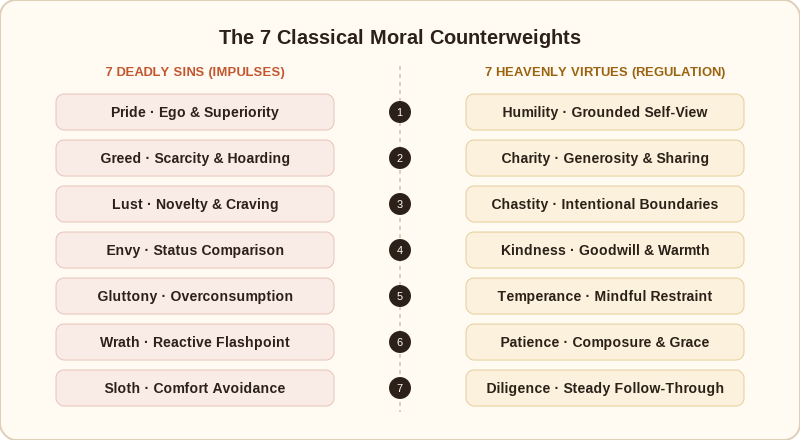
If you are looking up what is the opposite of the seven deadly sins, classical ethics never treated vices as isolated flaws. Every entry on the 7 deadly sins list pairs with an active corrective habit—known historically as the virtues opposite of 7 deadly sins or remedial virtues. Examining the 7 heavenly virtues and their sin counterparts shows how each pair operates like a psychological counterweight:
- Opposite of Pride → Humility: Replaces defensive ego and status-guarding with teachability and shared credit.
- Opposite of Greed → Charity: Counters tight-fisted scarcity anxiety with open-handed generosity and trust.
- Opposite of Lust → Chastity: Balances impulsive sensation-chasing with wholehearted focus and integrity.
- Opposite of Envy → Kindness: Dissolves silent status rivalry through sincere warmth and encouragement.
- Opposite of Gluttony → Temperance: Steadies all-or-nothing binges by honoring a sustainable boundary.
- Opposite of Wrath → Patience: Absorbs provocation and friction with composure rather than punitive heat.
- Opposite of Sloth → Diligence: Overcomes procrastination and avoidance through small, steady daily steps.
Seeing the opposite of every sin side by side explains why 7 sins and virtues endure in modern self-reflection: breaking an unhelpful habit rarely sticks unless you practice its positive replacement.
Classical Origins of the 7 Deadly Sins List
The traditional 7 deadly sins list originated in fourth-century monastic psychology, when Evagrius Ponticus cataloged eight destructive patterns that derailed focus. In 590 CE, Pope Gregory I distilled that catalog into the seven capital vices (caput meaning "head," because each root impulse generates smaller everyday habits). Paired with Prudentius's seven deadly sins and their opposites, this framework of 7 deadly sins and virtues later shaped Dante's Purgatorio and Chaucer's Canterbury Tales.
Measure Where You Land Across Both Lists
Reading the 7 deadly sins list makes it easy to guess your profile—until everyday scenarios test your actual reflexes. Start with our 28-question 7 Deadly Sins Test, measure your character strengths on the 7 Heavenly Virtues Test, or overlay all 14 traits together in our Sins vs Virtues Test.
All answers across every assessment are scored locally in your browser — never uploaded to a server. Every quiz is 100% free with unlimited retakes and works on iPhone (Safari), Android (Chrome), and desktop browsers with nothing to install.
No result notes posted on this page yet. Finish the quiz above and be the first to share your top percentage.