Why Measure All 14 Impulses and Regulating Habits Together?
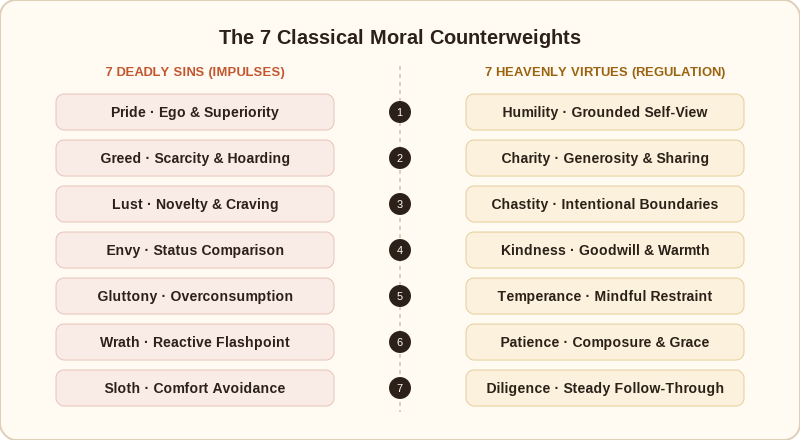
This sins vs virtues test scores all 14 classical traits at once—plotting your seven shadow impulses in crimson directly over your seven regulating habits in gold on one shared dual radar chart. Unlike the 7 heavenly virtues test, this one scores both sides on the same chart so you can see whether everyday behavior is steady or pulling in two directions at once.
Instead of assuming that low Greed automatically equals high Charity, independent dual-axis scoring uncovers three distinct patterns across each of the seven pairs:
- Clear Polarity (e.g., Charity 80% vs. Greed 25%): Your regulating habit comfortably outweighs the raw impulse even during stressful weeks.
- Low-Salience Axis (e.g., Lust 25% vs. Chastity 35%): Neither pole dominates your daily energy; your attention simply lives on other axes.
- High-Voltage Paradox (e.g., Wrath 75% AND Patience 70%): You feel intense internal heat when boundaries are crossed, yet you also invest heavy effort into staying composed. Spotting high-tension axes is the main reason to view both polygons on one dual radar.
Sins Test vs Virtues Test: What's the Difference?
When comparing the 7 heavenly virtues vs 7 deadly sins, each assessment examines a different side of how you respond to everyday pressure, ambition, and relationships:
| Dimension | 7 Deadly Sins Test | 7 Heavenly Virtues Test | 14-Trait Sins vs Virtues Test |
|---|---|---|---|
| Core Focus | Unfiltered stress impulses & blind spots (Pride, Greed, Lust, Envy, Gluttony, Wrath, Sloth) | Active self-command & character strengths (Humility, Charity, Chastity, Kindness, Temperance, Patience, Diligence) | Both sides measured independently to reveal polarity vs. internal tension |
| Questions & Time | 28 questions (~3 min) or 14Q Quick Mode (~90s); 4 items per sin | 28 questions (~3 min) or 14Q Quick Mode (~90s); 4 items per virtue | 28 questions (~3 min) or 14Q Quick Mode (~90s); 2 items per trait |
| Visual Output | Crimson 7-axis radar chart + Dominant & Runner-Up Sin PNG card | Golden 7-axis radar chart + Anchor Virtue PNG card | Overlaid crimson-vs-gold dual radar + 7 tug-of-war bars PNG card |
| Best Suited For | Spotting habits that trip you up when tired, rushed, or provoked | Identifying reliable personal strengths that keep you grounded | Seeing 7 heavenly virtues vs 7 deadly sins together in one sitting |
Which should you take first? If you want deeper 4-question-per-trait detail on your shadow triggers, start with our homepage 7 Deadly Sins Test. If you want to map your positive character habits first, take the 7 Heavenly Virtues Test. If you want to see both sides on a single compass right away, run the Sins vs Virtues Test at the top of this page.
The Four Moral Equilibrium Archetypes
When you complete all 28 items (two behavioral statements for each of the 14 traits, or one per trait in Quick 14-Question Mode), the calculator compares your two averages to classify your overall balance:
| Equilibrium Archetype | Score Signature | Everyday Personality Pattern |
|---|---|---|
| The Virtue-Guided Steward | Regulating average exceeds impulse average by 12%+ | Steady, deliberate, and conscientious; occasionally risks over-policing spontaneous desires. |
| The Dynamic Balancer | Both averages sit within 11% of each other | Pragmatic and adaptable; experiences normal human friction while keeping impulses within workable guardrails. |
| The High-Voltage Paradox | Both averages score 60%+ simultaneously | Deeply passionate and self-aware; feels desires, anger, or ambition strongly while actively practicing restraint. |
| The Unfiltered Maverick | Impulse average exceeds regulating average by 12%+ | Driven by raw appetite, candor, or comfort-seeking; thrives on autonomy but benefits from clearer daily friction brakes. |
How to Read Your 7 Tug-of-War Bars
Beneath your dual radar chart, check first whichever horizontal pair shows the widest gap, and second whichever pair carries the highest combined score. To zoom into either side with deeper four-question-per-axis precision, take our flagship 7 Deadly Sins Test, our dedicated 7 Heavenly Virtues Test, or consult the complete 7 deadly sins list.
No result notes posted on this page yet. Finish the quiz above and be the first to share your top percentage.